
Establishing the Oldest Date of Human Activity in Lombard with the Illinois State Archaeologist
/Lombard’s History Just Got 8,000 Years Older
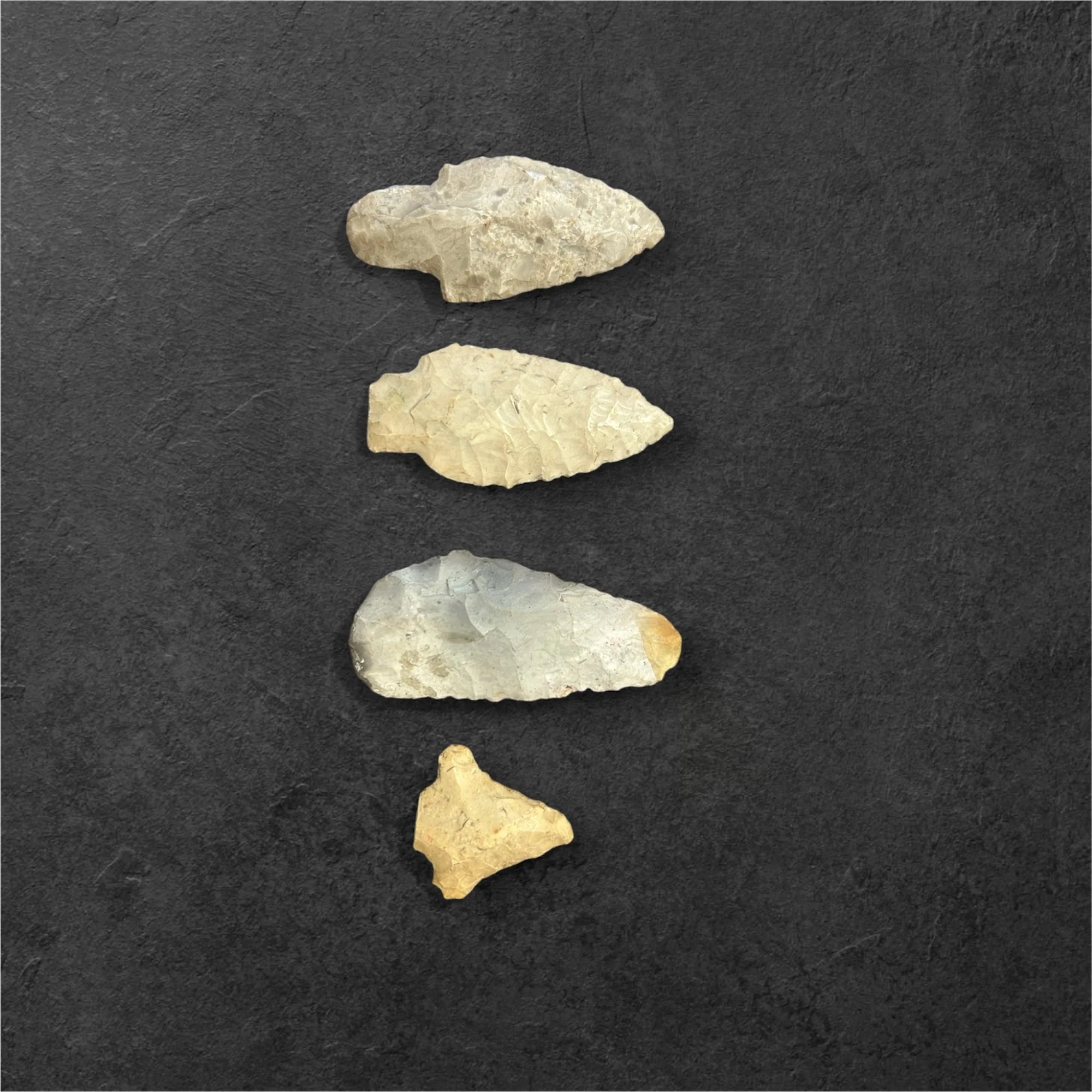
The Mrs. Gary Collection, Lombard Historical Society Collection, A-75-130, 1975.
A recent study (click the link to read) published in Illinois Antiquity (Vol. 60, No. 4) has reshaped what we know about Lombard’s earliest past. New research has identified the oldest known evidence of human activity within the village, dating back nearly 8,000 years, and it all started with a small group of stone tools that had quietly sat in our collections for decades.
The story begins with the Mrs. Gary Collection, a set of artifacts donated to the Lombard Historical Society in 1972 by Jean Paris, also known as Mrs. Gary. At the time, the items were described simply as four arrowheads of unknown date and were reportedly found in the area we now know as the Lombard Common a park operated by the Lombard Park District. For years, they remained largely overlooked in the LHS collection.
Peck_Mertz Collection 1, Frank Peck, Harriet Peck, east view across Grace to future Lombard Common park, circa 1920s, lombard historical society collection.
Lombard Memorial Park Plans (Lombard Common Today), Designed by William rose and Robert mudra, February 1953, Lombard Historical Society Collection.
Digging into the Past
This Summer, LHS partnered with the Illinois State Archaeological Survey. As part of the collaboration, ISAS archaeologists led hands on training workshops for LHS staff and took a closer look at LHS’s legacy collections, including the Mrs. Gary artifacts. What we found was remarkable…
Careful analysis by ISAS revealed that the collection spans thousands of years and multiple periods of human activity. The oldest piece, a finely made Fox Valley dart point, dates to around 6,000 BCE and marks some of the earliest known human presence in Lombard. Other tools suggest Late Archaic activity between roughly 1,400 and 800 BCE, while the most recent artifact, an Adena Waubesa point or knife, dates to the Woodland period from 600 BCE to 150 CE. Together, these objects show that people returned to this area again and again over millennia and that Lombard was connected to broader networks of shared technology and traditions across the Midwest.
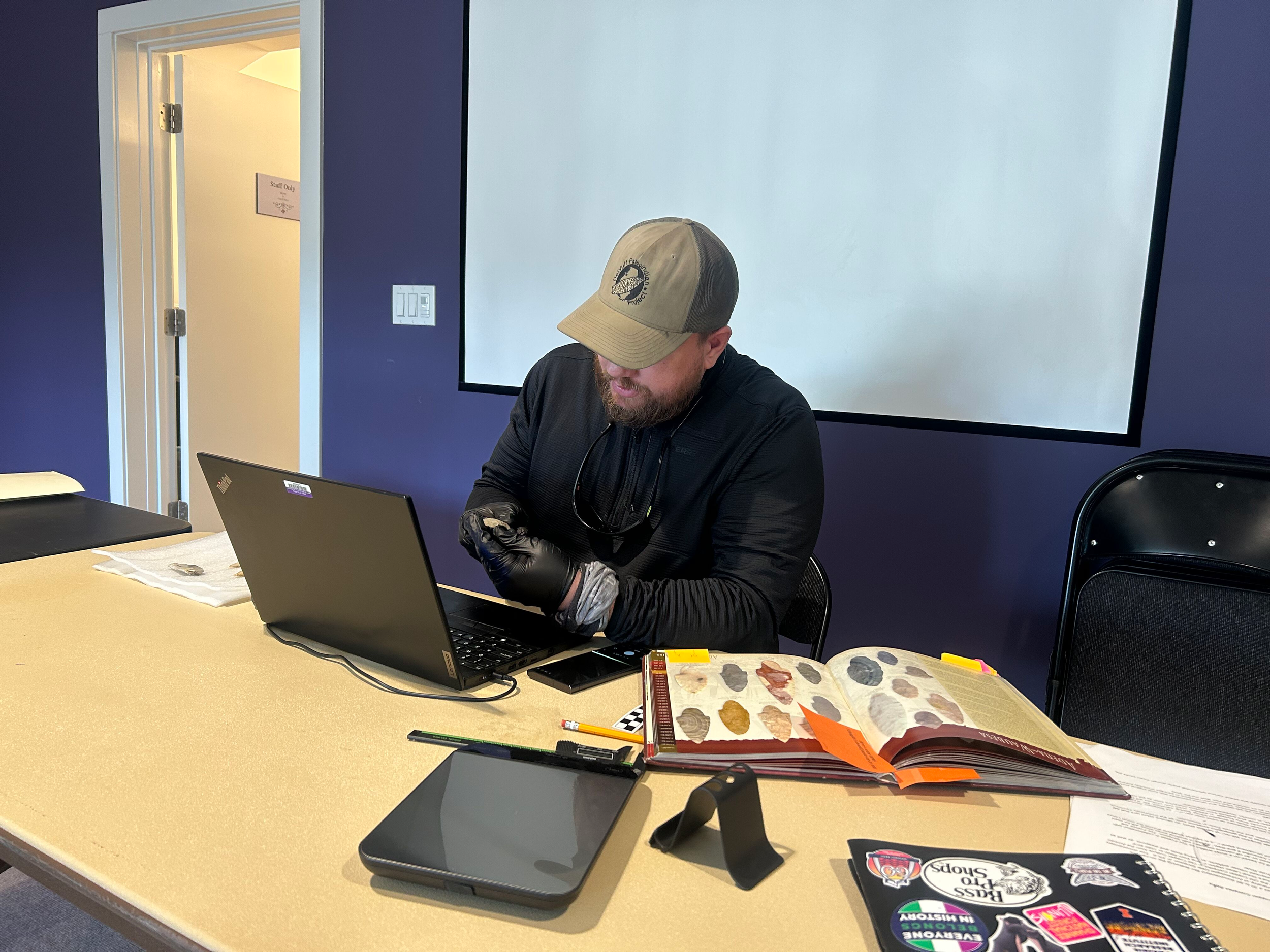
Dale F. Simpson Jr., ISAS Senior Scientific Specialist and anthropology instructor at the College of DuPage and Elgin Community College, 2025.
“This collection transforms our understanding of Lombard’s human history,” said Dale F. Simpson Jr., ISAS Senior Scientific Specialist and anthropology instructor at the College of DuPage and Elgin Community College. “What was once thought to be a small group of local arrowheads now tells a story of nearly 8,000 years of human presence, from Early Archaic hunters to Woodland period communities, linking Lombard to major developments across northern Illinois.”
Madeleine Evans, Senior Lithic Research Analyst at ISAS, highlighted the importance of taking another look at long held collections. “Revisiting legacy collections like Mrs. Gary’s is crucial,” she said. “It allows us to uncover stories that were overlooked or inaccessible to earlier researchers and reminds us just how valuable museum and historical society collections can be.”
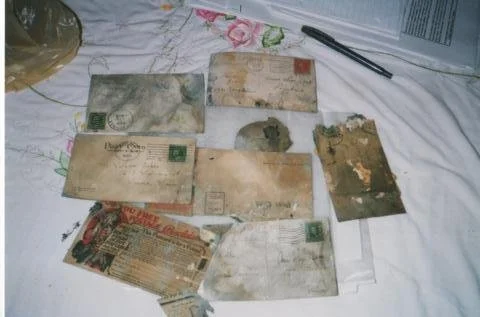
Artifacts discoverd during the restoraiton of the SHeldon Peck Homestead, lombard historical Society collection, 1999.
For LHS, the discovery reinforces the importance of preserving and caring for these materials. “This finding underscores the role of historical societies as living archives,” said Alison Costanzo, Executive Director of the Lombard Historical Society. “These artifacts connect our community to a much deeper past, one that extends far beyond the more familiar pioneer era history represented by sites like the Sheldon Peck Homestead.”
Reshaping History
The site is now officially recorded as the Mrs. Gary Site (11DU629) by ISAS, making it the first recognized pre-contact archaeological site within Lombard. It is a powerful reminder that even small collections can hold big stories and that by revisiting and reinterpreting them, we can continue to uncover new chapters of Lombard’s history.
Help Us Continue the Story
Discoveries like the Mrs. Gary Collection remind us that Lombard’s history is still being uncovered. If you are a Lombard resident and have found artifacts in your yard while gardening, landscaping, or doing construction projects, we would love to hear from you by filling the form out below or email us at director@lombardhistory.org.
Sharing this information helps us better understand where people lived, traveled, and gathered long before Lombard became the community we know today. Together, we can continue building a fuller and more inclusive narrative of Lombard’s deep past.
A Special thank You…
This project would not have been possible without the generosity, expertise, and collaboration of many partners. We extend our sincere thanks to Dale F. Simpson Jr. and Madeleine Evans for sharing their knowledge and for guiding the reanalysis of the Mrs. Gary Collection. We are also grateful to the Illinois State Archaeological Survey for their partnership, training, and continued support of responsible archaeological research. Finally, we thank the Illinois Association for Advancement of Archaeology for their dedication to promoting archaeological understanding and public stewardship across Illinois. Together, these collaborations help ensure that Lombard’s history continues to be studied, preserved, and shared.
